Does AI really have a place in football?

Ever since I watched the Google DeepMind documentary, one thing has kept playing in my head: AlphaGo, reinforcement learning, and how that concept could be brought into football.
That question stuck with me. So I did a bit of digging to see how AI is already being implemented in football today, and I thought I’d put my thoughts and findings into writing.
Before diving in, I want to make one thing clear: I genuinely believe there’s a huge opportunity for AI in football and in my opinion, it’s still being under-explored, especially when it comes to tactics, preparation, and decision-making. In this article, I’ll focus on two Premier League examples:
Liverpool, and their use of pitch control models
Brighton & Hove Albion, and their data-driven philosophy
But first, we need to properly understand the idea that sparked all of this: reinforcement learning.
Reinforcement Learning
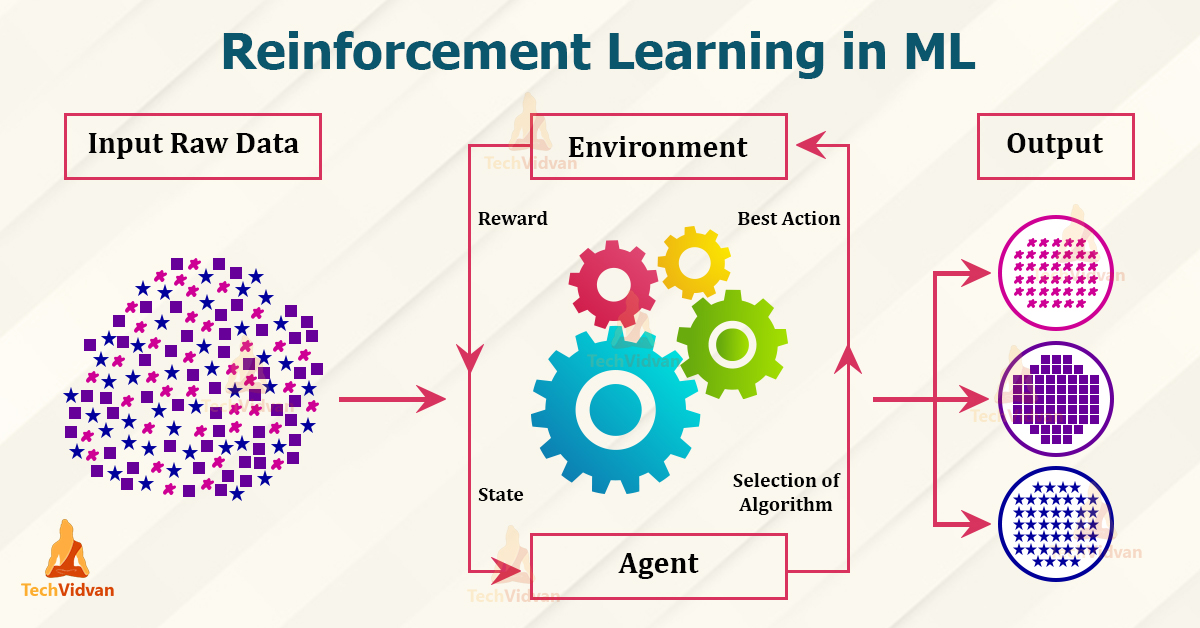
Reinforcement learning (RL) is a branch of machine learning where an agent learns to make decisions by interacting with an environment in order to maximise a reward signal. Unlike supervised learning which learns from labelled examples reinforcement learning learns through experience, using trial and error to figure out what actions lead to better outcomes over time.
One of the most famous examples of this is AlphaGo, the AI developed by DeepMind to play the ancient board game Go. Go is an incredibly complex game, with more possible board configurations than atoms in the observable universe. This makes it practically impossible to “solve” through brute force. Instead of simply copying human strategies, AlphaGo learned in two key stages:
It studied games played by professional Go players to recognise patterns
It then played millions of games against itself, learning which decisions led to winning outcomes
Through this process of self-play, AlphaGo wasn’t just memorising moves it was also learning how decisions influence future states of the game. Over time, it developed strategies that even elite human players had never considered, eventually defeating the best Go players in the world.

The success of AlphaGo was driven by two core ideas:
Pattern recognition learned from past games
Simulation-based optimisation through reinforcement learning
This got me thinking: If reinforcement learning and simulation can master a game as complex as Go, could similar ideas help with football tactics and match preparation?
Why Football Is Harder But Still Interesting
Of course, football is far harder to model than a board game.
It’s continuous rather than turn-based. Players are constantly moving. Human behaviour is unpredictable. Refereeing decisions, player quality, fatigue, confidence, weather, and psychology all play a role. The environment is chaotic and open-ended. But despite all of this, football isn’t random.
Teams follow patterns. Managers have philosophies. Pressing triggers repeat. Build-up shapes recur. Opponents tend to respond in familiar ways. And it’s within these recurring structures that AI can start to add real value.
When this question of AI in football first popped into my head, I made a LinkedIn post to get other people’s perspectives on the idea. In that post, I mentioned a manager like Pep Guardiola.

His philosophy is well known. There are clear principles, recurring structures, pressing patterns, and build-up shapes that appear again and again across seasons and teams. So the question becomes: why can’t we partly treat football like a reinforcement learning problem?
For example:
Take Pep Guardiola’s last 30 matches
Simulate them against different formations and tactical setups of your own team
Optimise for scenarios such as pressing success, chance creation, and defensive stability
You of course wouldn’t be removing the human element but I think you very much set your team up for better chance of success and that’s where real-world examples like Liverpool and Brighton become particularly interesting.
Liverpool Pitch Control Models

One of the most advanced applications of AI-inspired thinking in football analytics comes from Liverpool FC. Rather than relying purely on traditional event data passes, shots, tackles, Liverpool have been associated with the use of pitch control models. These models aim to quantify which team controls which areas of the pitch at any given moment.
At a high level, a pitch control model estimates the probability that a team can reach or control a specific location on the pitch before the opponent. To do this, it considers factors such as:
Player positions
Movement speed and direction
Distance to the ball
Team shape and spacing
The result is a continuous spatial representation of dominance, rather than a simple list of actions. Using these models, analysts and coaches can explore questions like:
Where is space being created or conceded during build-up?
Which pressing actions are most effective?
How do certain attacking patterns manipulate defensive structures?
In other words, pitch control models help translate the chaos of a football match into quantifiable, tactical insight. While this isn’t reinforcement learning in the pure AlphaGo sense, it forms a critical building block. These spatial models can feed into broader decision frameworks predictive simulations, opponent modelling, or even future optimisation systems that test tactical ideas before they’re ever tried on the pitch.
(Source: William Spearman on pitch control models, Training Ground Guru)
Brighton’s Data-Driven Approach
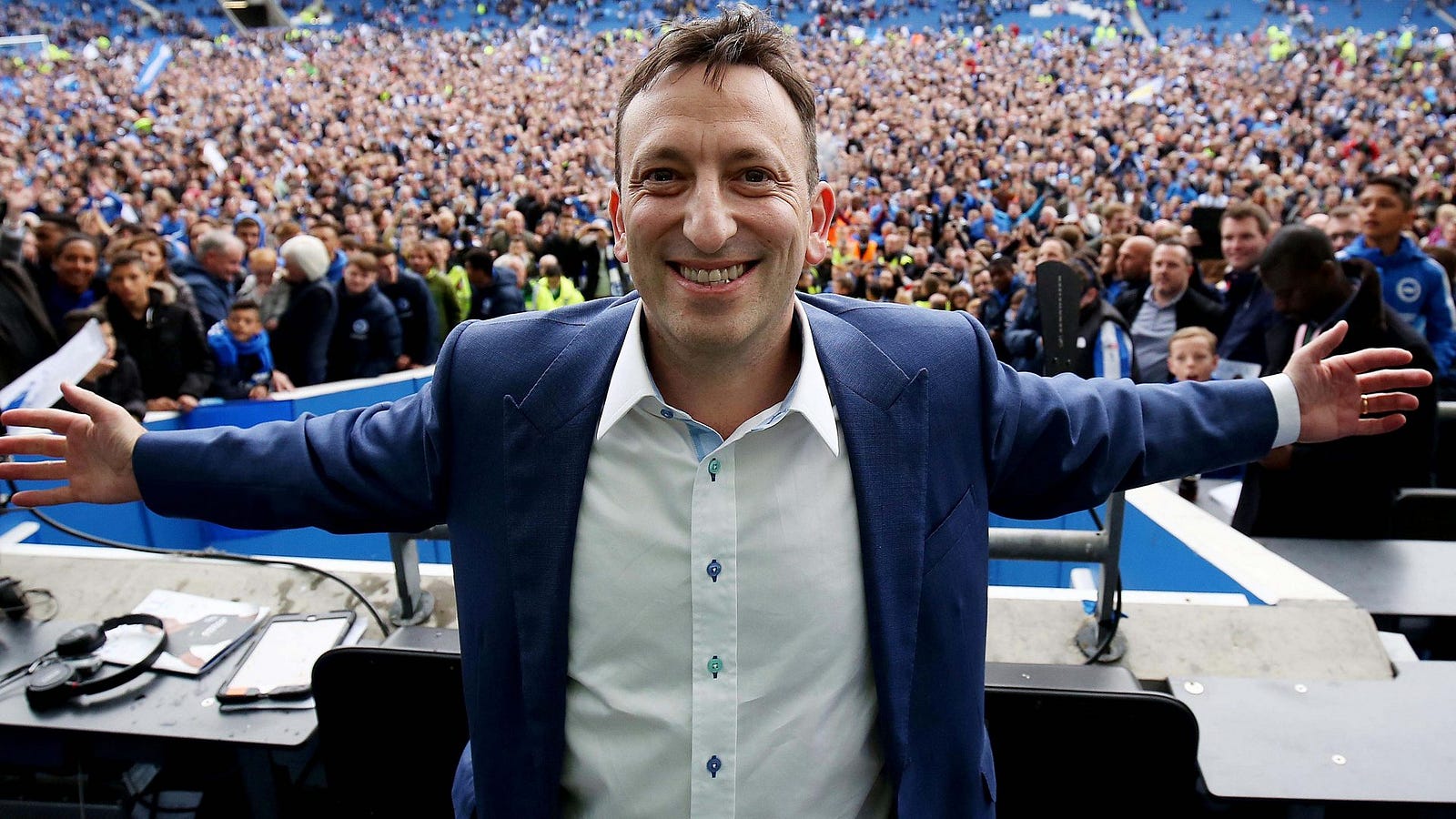
Another club frequently highlighted for its use of analytics is Brighton & Hove Albion.
Brighton have developed a reputation for adopting a data-centric philosophy across the club from recruitment and squad building to tactical planning and performance analysis. Much of this approach can be traced back to their chairman, Tony Bloom, whose background in data analysis and modelling has heavily influenced the club’s long-term strategy.
Unlike clubs that rely heavily on intuition or traditional scouting alone, Brighton place strong emphasis on:
Statistical profiling of players
Advanced performance metrics
Data-supported tactical decisions
Integrating analytical insights into coaching discussions
This doesn’t necessarily mean Brighton are running reinforcement learning simulations for match tactics at least not publicly but it does demonstrate how deeply data can shape real football decisions when it’s embedded at an organisational level.
Brighton’s ability to compete consistently at a high level, often against clubs with significantly larger budgets, shows how intelligent use of data can reduce uncertainty and create sustainable competitive advantages. Crucially, Brighton’s approach doesn’t remove the human element. Instead, it uses data to support judgement rather than replace it giving decision-makers better information, not rigid instructions.
Conclusion
Football may never be “solved” in the same way Go was and that’s probably a good thing. But there’s growing evidence that AI and analytics already have a meaningful place in the sport. From Liverpool’s pitch control models that turn spatial dynamics into tactical insight, to Brighton embedding data into decision-making across the club, football is clearly evolving.
I believe there’s a huge opportunity for innovation here especially around match preparation, tactical planning, and scenario modelling. In the same way AI tools helps us as software engineers work more efficiently, AI can help coaches make better-informed choices and send teams into matches with better odds and clearer preparation for different scenarios.
Reinforcement learning and simulation, the ideas that powered AlphaGo offer a conceptual framework for how this might develop. The real challenge isn’t a lack of potential, but the difficulty of modelling humans in open, unpredictable environments. Football isn’t Go but perhaps parts of it can be treated as dynamic decision problems. And as tracking data, modelling techniques, and AI systems improve, the line between intuition and computation in football will only continue to blur.


